
Why Dynamic Facets Matter in E-Commerce Search
Search filters help shoppers narrow down large product selections and quickly find the items that match their needs. However, static filters can slow shoppers down when they display options that are not relevant to the current search results.
When every possible facet appears regardless of context, shoppers may need to scan long lists of filters that do not apply to their query. This creates unnecessary friction and makes product discovery more difficult.
Dynamic facets solve this by displaying only the filters that are relevant to the current search results.
Instead of overwhelming shoppers with irrelevant options, the filtering system adapts to the search context. This transforms faceted search into a guided navigation experience that helps shoppers refine results more efficiently.
From Static Filters to Context-Aware Facets
Traditional faceted navigation often displays the same set of filters for every search query.
While this approach may work for smaller catalogs, it can become overwhelming in larger stores with many attributes such as brand, size, material, color, or style.
Dynamic facets automatically adapt to the active result set and display only meaningful filtering options.
Facet values that do not match any results are removed, keeping the filtering experience focused and useful. This reduces clutter and helps shoppers concentrate on filters that actually refine their results.
How Dynamic Facets Work
Query-Aware Facets Only filters relevant to the current search results are displayed.
Automatic Value Pruning Facet values that have no matching products are hidden.
Smarter Navigation Shoppers can narrow results without encountering filters that lead to empty pages.
Clerk.io automatically recalculates facets based on the active result set, ensuring filters always reflect available products.
Use Case: Faster Filtering, Fewer Drop-Offs
A fashion retailer offers thousands of products across categories, brands, sizes, colors, and materials.
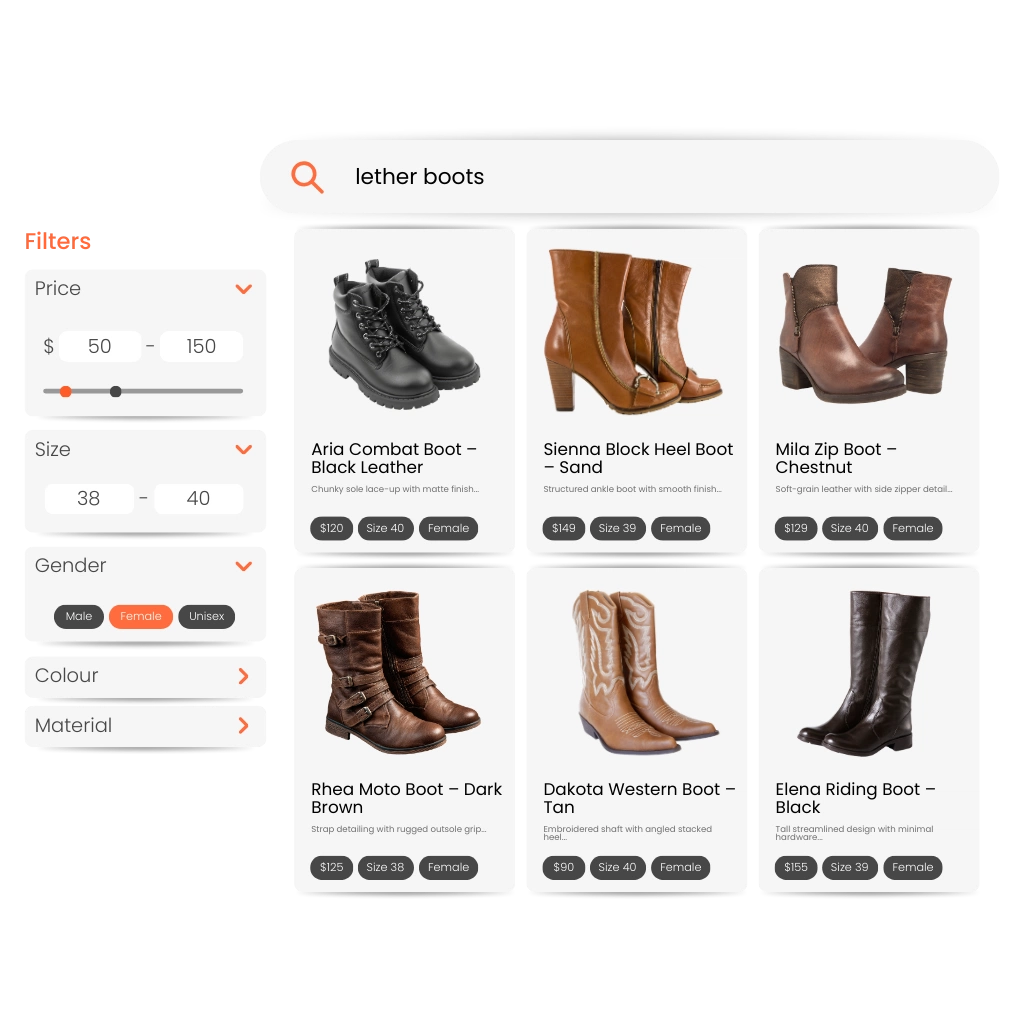
With static filters, a search for “black leather boots” may still show unrelated filters such as running types or irrelevant materials.
With dynamic facets, only relevant filters appear, such as leather type, brand, price range, heel height, and available sizes.
Shoppers can refine results in fewer clicks and reach the right products faster.
Key Benefits of Dynamic Faceted Filters
- Show only filters relevant to the current search
- Reduce friction in product discovery
- Help shoppers refine results more quickly
- Avoid dead-end filters with zero results
- Improve usability across large catalogs
By adapting filters to each search query, dynamic facets help shoppers navigate large product catalogs more efficiently and discover relevant products faster.