Why a Customer Data Platform Matters in E-Commerce
Customer data often exists across multiple tools, channels, and touchpoints. When this information is fragmented, it becomes difficult for businesses to build a complete understanding of each customer.
Without a unified view, personalization and targeting rely on partial signals. Recommendations, marketing campaigns, and onsite experiences may operate on different data sources, which can lead to inconsistent interactions across the customer journey.
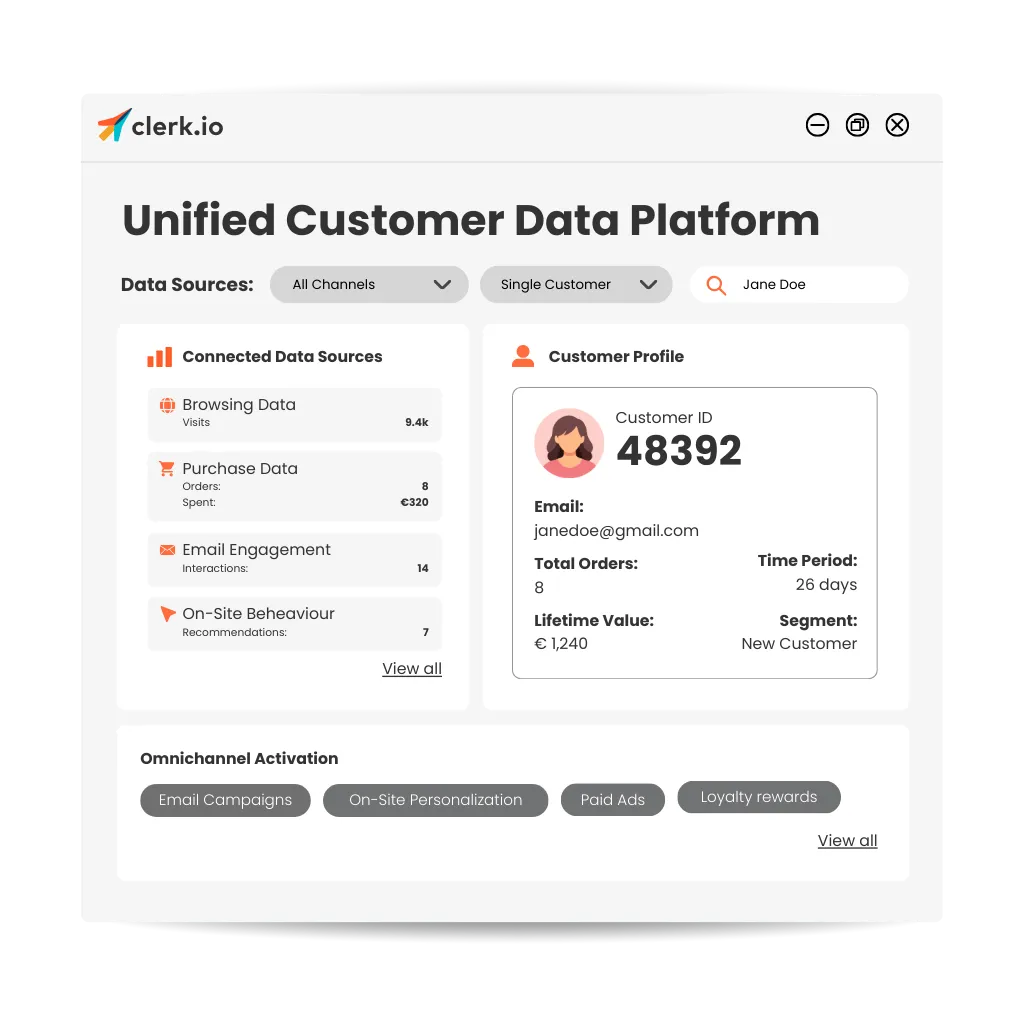
A customer data platform (CDP) solves this challenge by bringing behavioral, purchase, and engagement data together into a single unified customer profile.
With this foundation, businesses can power personalization, segmentation, and marketing using the same consistent set of customer insights. This creates a more accurate understanding of each shopper and enables more relevant experiences across channels.
From Fragmented Data to Unified Customer Profiles
Many e-commerce businesses collect large volumes of customer data but struggle to connect it across systems.
Without a unified data layer, different tools operate with separate datasets. This can lead to inconsistent targeting, disconnected personalization, and marketing decisions based on incomplete information.
A customer data platform consolidates these signals into a persistent customer profile.
By combining behavioral activity, purchase history, and engagement data, businesses gain a more complete picture of each shopper. This allows features such as product recommendations, campaigns, and segmentation to operate using the same accurate and up-to-date information.
As customer activity evolves, profiles update automatically, ensuring insights remain relevant over time.
How a Customer Data Platform Works
Cross-Channel Data Collection Combine browsing behavior, purchase activity, and interaction data from multiple systems and touchpoints.
Unified Customer Profiles Create a single persistent profile for each customer across sessions, devices, and channels.
Activation-Ready Data Use unified profiles to power personalization, segmentation, recommendations, and marketing campaigns.
Clerk.io continuously collects and connects customer signals to maintain accurate, up-to-date profiles for every shopper.
Use Case: Powering Consistent Personalization
An e-commerce brand uses separate tools for search, product recommendations, and marketing automation.
Without a unified data layer, each system relies on different pieces of customer information. This can lead to inconsistent targeting and personalization across channels.
With a customer data platform in place, all features operate using the same unified customer profile. This enables consistent personalization throughout the entire customer journey.
Key Benefits of an E-Commerce Customer Data Platform
- Unified customer profiles across channels and devices
- Centralized behavioral and transactional data
- More accurate personalization and targeting
- Consistent experiences across marketing and onsite interactions
- A stronger foundation for segmentation and recommendations
By connecting customer data into a single profile, e-commerce brands can deliver more relevant and consistent customer experiences.