
Why Custom Data Segmentation Matters in E-Commerce
Standard segmentation tools typically rely on predefined categories such as purchase history, browsing activity, or location. While useful, these segments do not always capture the full picture of your customers.
Many e-commerce brands collect additional data such as loyalty tiers, preferences, demographics, or internal scoring models. Without the ability to use these signals in segmentation, that data often remains underutilized.
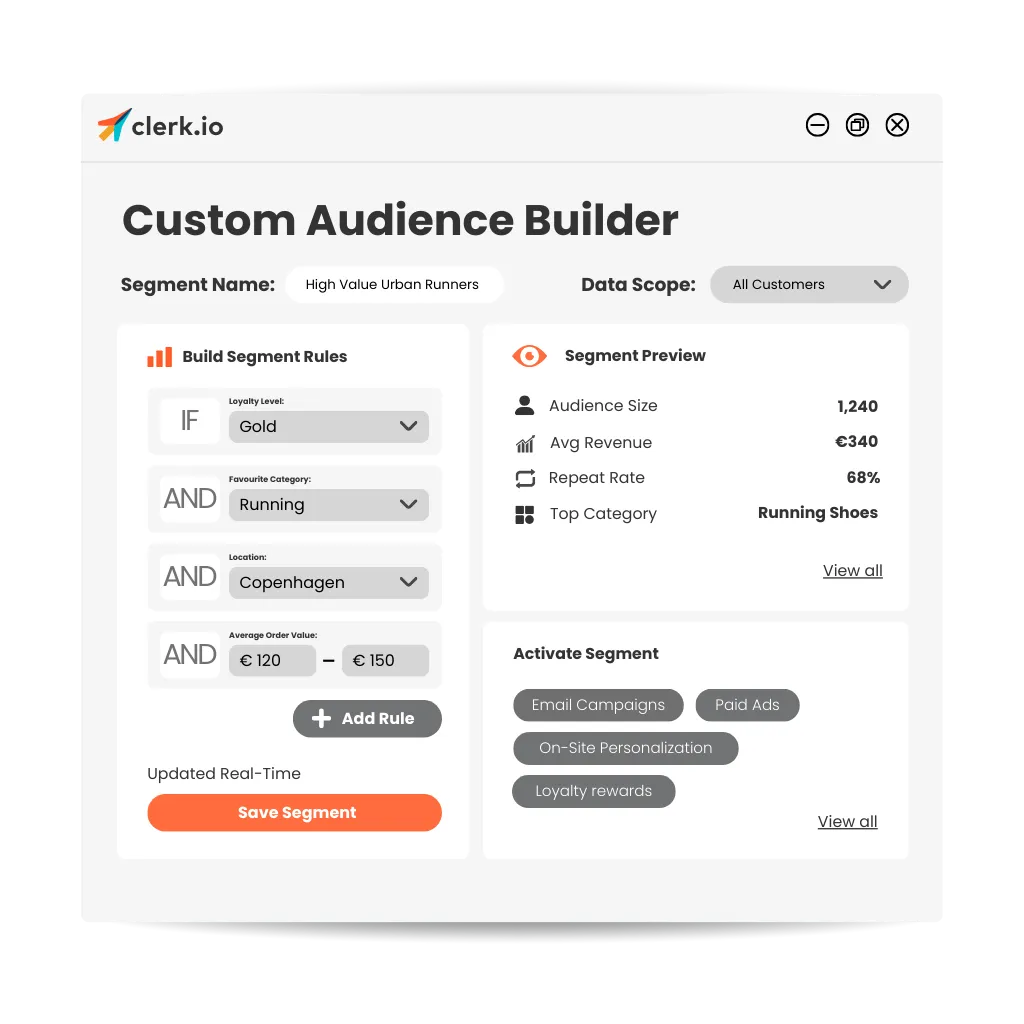
Custom data segmentation allows businesses to build audiences using their own attributes and metadata.
Instead of relying only on built-in metrics, brands can combine behavioral signals with business-specific data to create more precise targeting. This enables marketing and personalization strategies that better reflect how the business actually understands its customers.
By activating internal data alongside behavioral insights, companies can create audience segments that are more relevant and actionable.
From Standard Segments to Business-Specific Audiences
Predefined segmentation works well for common use cases, but it can limit flexibility when brands want to target customers using internal data models.
Custom segmentation removes this limitation.
Clerk.io allows businesses to ingest their own customer attributes and combine them with behavioral and transactional signals. These data points can then be used to define audiences that align with real business logic.
Because segments update dynamically as customer data changes, targeting remains accurate over time without requiring manual updates.
This allows brands to build segmentation strategies that evolve alongside their customer data.
How Custom Data Segmentation Works
Custom Fields Segment customers using custom attributes, tags, or internal data fields.
Flexible Rules Combine multiple signals such as browsing behavior, purchases, and metadata.
Dynamic Updates Segments automatically update as customer data evolves.
Clerk.io allows brands to ingest custom customer data and activate it alongside behavioral and transactional signals for more precise audience targeting.
Use Case: Segmenting Beyond Standard Metrics
An e-commerce brand tracks customer preferences, loyalty tiers, and demographic information.
Without custom segmentation, these insights are difficult to use for targeted marketing or personalization.
With custom data segmentation, the brand can create audiences based on its own customer attributes. This allows marketing campaigns, product recommendations, and personalization strategies to better reflect real customer relationships.
Key Benefits of Custom Data Segmentation
- Audience targeting based on business-specific data
- Combination of behavioral, transactional, and custom attributes
- More precise marketing and personalization strategies
- Dynamic segments that update automatically
- Greater flexibility in campaign and recommendation targeting
By unlocking custom data signals, e-commerce brands can move beyond generic segmentation and create audiences that reflect their real customer insights.